✓ RealRankly Editors·Updated October 2026·10 options reviewed·100+ sources analysed
Choosing the right sports option requires balancing performance, value for money, and design - priorities that vary widely between buyers. We evaluated 10 options across 8 criteria to help you make a confident, informed decision. Adjust the sliders above to weight each criterion to match your own needs and see the ranking update in real time.
Share:
💬 What real owners actually say
Synthesized from 2026 owner reviews & discussions across social media — the things spec sheets leave out.
8x42 is the do-everything default. Reviewers and owners keep landing on 8x42 as the best all-round pick — enough magnification for birds and wildlife with a wide, steady field of view. It’s the size to buy first if you’re unsure.
Exit pupil and stability matter more than raw power. A recurring expert note: beginners chase magnification, but exit pupil and hand-holdability decide how usable a pair really is. Jump to 10x and the image shake becomes obvious without a tripod.
Match the spec to the job. 10x42 gives the best balance for handheld long-distance viewing, while stargazers are steered toward 10x50 for the light-gathering — higher powers than that genuinely need a tripod or image stabilization.
Image stabilization is a real category — with a caveat. Owners love Canon’s stabilized binoculars for locking the view, but some report the external coating degrading over the years, so weigh long-term durability against the wow factor.
You get what you pay for in glass, but the value tier is strong. Premium names (Swarovski, and the compact CL line) draw devotion, yet mid-priced Vortex and NOCS models earn repeat praise for delivering most of the view for a fraction of the price — the sweet spot for most buyers.
Each slider sets how much each criterion matters to you (0 = ignore, 10 = critical).
Ranked Results
Default weights - scroll up to customise
What the review covers — Digital Tech Reviews
Key points from Digital Tech Reviews’s review, a value-to-flagship top-5 — plus the full video below.
It ranks a ladder from value to flagship — Nikon Aculon, Vortex Diamondback HD, Nikon Monarch M7, Canon IS, and Swarovski NL Pure.
10x42 (and 10x50) dominate the picks — the versatile all-rounder for birding, wildlife and stargazing.
Canon’s image-stabilized model is singled out for locking the view — a real category for handheld long-distance use.
Premium glass (Swarovski) is stunning, but mid-priced Vortex and Nikon deliver most of the view for far less — the value sweet spot.
Source: Digital Tech Reviews (video). Points summarized from the review; see the video for full detail.
Every RealRankly ranking is scored 0–100 on 8 independent criteria, and no company can pay to change a score. Use the weight sliders above to reweight the criteria to your own priorities. How we rank →
More videos on this topic
How To Choose Binoculars: What Size is Best for Your Activities? Vortex 8x42 vs 12x50 vs 18x56 TEST
Sports and Gadgets
5 Best Binoculars 2026 | Top Birdwatching, Wildlife & Stargazing Picks
HowMuchTech
The 2 best binoculars for watching birds, baseball or just about anything
CNN
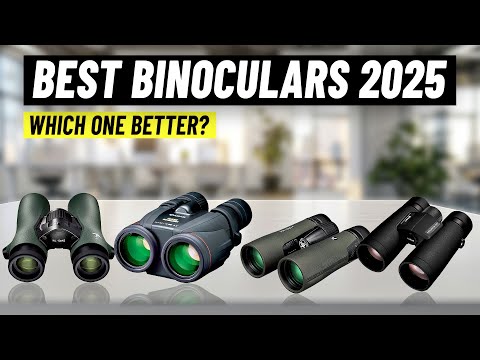
Best Binoculars 2026 [Don't Buy Until You WATCH This!]


![Best Binoculars 2026 [Don't Buy Until You WATCH This!]](https://i.ytimg.com/vi/BypIJ80NuSs/hqdefault.jpg)